
Conference: Historiography of the Baltic Sea Region. Current State and Further Perspectives
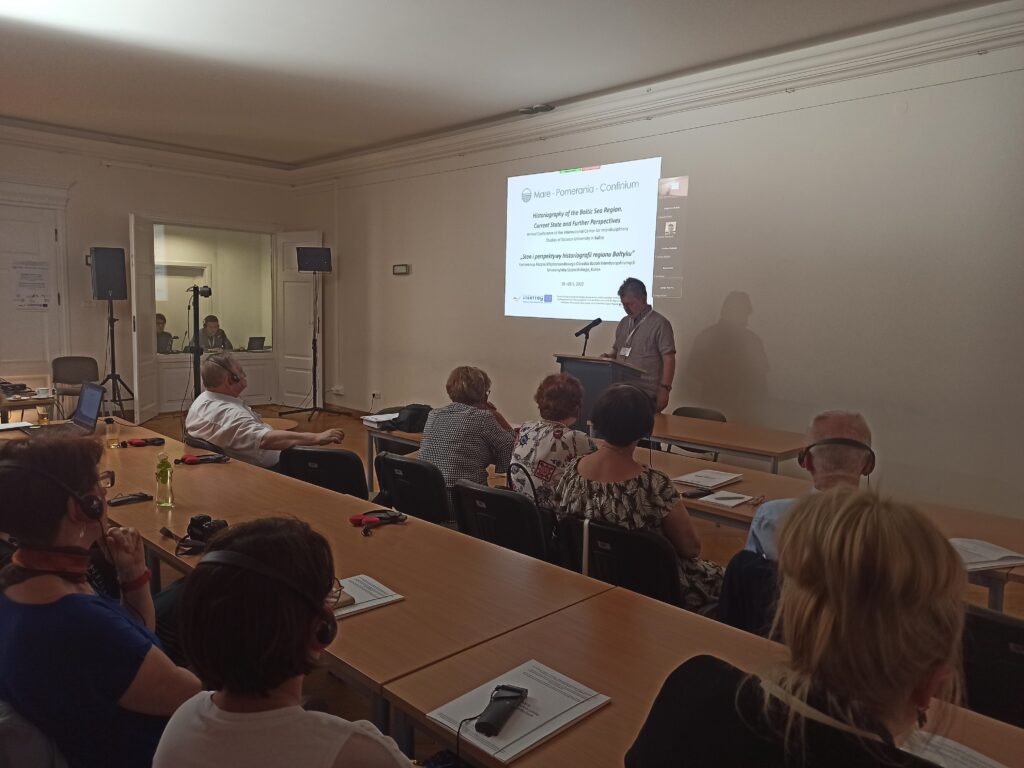
On 19-20 May 2022, a conference was held at MOBI in Kulice entitled. “Historiography of the Baltic Sea Region. Current State and Further Perspectives”, prepared by MOBI Director Prof. Jörg Hackmann. The event had a hybrid character, as some of the speakers and participants were on-site, while others participated online. It featured 6 papers: The North-Western Slavs in Polish, German and Danish Historiography until the mid-20th century. A contribution to the historiographical image of the Baltic historical region (Paweł Migdalski); Tourism on the Baltic rim, 1800-1990 (Jan-Hinnerk Antons); Europa litterata. Szymon Starowolski – Johannes Scheffer – Johann Moller – Benjamin Potzerne (Agnieszka Borysowska); Of Culture Bearers and Conquerors: The Reception and Interpretation of the Medieval Eastern Settlement in Wagrien (18th to 19th Centuries) (Stefan Brenner); Immigration to the Baltic and especially to Northern Europe during the Medieval Ages and the Early Modern Era – Demography and Integration (Jens E. Olesen); The Hidden Entanglements of Doing Baltic Historiography in the Cold War (Jörg Hackmann). The papers, although they dealt with very different issues, showed the need for deepening mutual cooperation between historians from different countries in the study of Baltic issues and the necessity of comparative research.
At the end of the event a very interesting debate took place entitled “Writing the history of the Baltic Sea Region. National perspectives and transnational challenges”, in which Jörg Hackmann, Karsten Brüggemann (Tallinn), Bogusław Dybaś (Toruń) and Jan Hecker-Stampehl (Köln) participated,
Jüri Kivimäe (Toronto/Tallinn) and Bradley Woodworth (New Haven). Other listeners, such as Bert Becker (Hong-Kong), also joined the discussion. It is worth noting here that the discussants stressed that the Baltic Sea issue is now and will continue to be a very important part of the political discourse in the world, due to the intersecting interests of different states in the current political situation and the need for comparison with other internal seas, such as the Black Sea or the South China Sea.
Check out the photo report on FB.